Day ShiftDay Shift / Local CLI

Keep coding-agent work aligned across sessions

Stop losing the plan when coding-agent work moves beyond one chat.

Day Shift is a local CLI that keeps coding-agent plans, scope, validation evidence, and handoff records in your repository. These records give humans and coding agents a shared continuation point across sessions, tools, and contributors. As a local CLI and repository workflow layer, Day Shift writes the plan, the implementation evidence, and the review record into your repository and works around the coding assistants you already use instead of replacing them.

Free to evaluate: download and run the complete local workflow with no signup, no license file, and no online activation.
Install Surface
Website-owned release URLs
Runtime Posture
Local-first after install
Planning Model
Basic · Structured · Governed

Who it is for

Built for teams already using coding agents for real work.

Solo builders and founders

Keep coding-agent sessions from turning into archaeology across chat, code, TODOs, and project notes.

Staff engineers and tech leads

Delegate agent work with visible scope, review evidence, validation evidence, and handoff records.

Agencies and consultants

Ship governed client work with a durable agreement and evidence instead of scattered transcripts.

Platform teams

Standardize the handoff layer between humans, agents, models, and deterministic repository checks.

Agent work drifts when the contract lives in chat.

Specs, screenshots, tickets, and half-remembered decisions do not give reviewers a durable record of what was intended or what changed.

Day Shift puts the contract in the repository.

The work agreement, implementation evidence, validation evidence, and handoff record stay visible beside the code instead of disappearing with the session.

Use judgment where it matters.

Deterministic CLI checks handle structure and traceability while frontier models stay focused on ambiguous product intent, architecture, and risky changes.

Before and after

The same agent work, with and without a durable record.

Without Day Shift

  • The plan lives in a chat transcript that scrolls away.
  • Nobody can say which files a task was allowed to touch.
  • Validation results vanish when the session ends.
  • Review means re-reading diffs and guessing at intent.
  • Every handoff restarts from zero context.

With Day Shift

  • The plan is a versioned artifact beside the code it governs.
  • Each task declares scope, target paths, and validation up front.
  • Implementation summaries record what changed and what passed.
  • Milestone reconciliation gives reviewers one explicit checkpoint.
  • Any contributor, human or agent, continues from the repository record.

Qualified Basic evaluation proof

One scoped task, from complete request to reviewable result.

Current clean-and-dirty repository evidence proves the fastest Day Shift path without hiding who implemented, what validation ran, or which explicit action changed lifecycle state.

Starting state

  • No specification, work overview, slice, phase, milestone, reconciliation, or Basic-specific index.
  • One numbered parentless root: .day-shift/planning/basic/tasks/01-basic-evaluation.
  • One task definition paired with one implementation summary.

Completed state

  • One explicitly selected validation ran through Day Shift command-owned child process.
  • Read-only review stayed separate from accepted disposition and closeout.
  • Second-session next action: none (terminal_state).
Prompt: "Create one Basic task from this complete request using guided mode and hybrid evidence."
outcome: created .day-shift/planning/basic/tasks/01-basic-evaluation/task-definition.md
outcome: paired .day-shift/planning/basic/tasks/01-basic-evaluation/implementation-summary.md

Prompt: "Run one explicitly selected declared validation check and record the result for this task."
outcome: exit 0

Prompt: "From this task artifact, tell me the next action from current repository evidence."
outcome: next action none

Basic is the fastest path for one scoped task. Structured remains the normal path for specification-backed or coordinated feature work.

Normal planned-feature workflow

Turn one reviewed feature specification into a plan the whole team can continue.

After the one-task Basic example, Structured is the normal path for planned feature work. With a valid specification and no explicit workflow level, Day Shift selects Structured and creates one shared overview with direct implementation tasks.

One shared feature plan

The canonical specification stays under .day-shift/specs/. The Structured overview records its revision and points back to it instead of relocating or copying the requirements.

The qualified example resolves to structured, keeps the specification at .day-shift/specs/31-structured-evaluation-source/structured-evaluation-source.md, and creates 2 numbered direct tasks in declared dependency order.

Review and closeout stay explicit

Task evidence rolls up to a read-only project review. Persisting project-review.md and closing the work remain two separate explicit actions.

The release gate confirms read-only work review, explicit project-review persistence, and separate closeout without introducing Governed hierarchy into the normal feature path.

Product workflow

Start small, then use the normal workflow for planned feature work.

Basic may appear first without becoming the CLI default. Basic, Structured, and Governed organize work; they are not pricing or capability tiers. The choice does not change your coding agent, grant write authority, or replace a product specification. Day Shift is a local CLI that keeps coding-agent plans, scope, validation evidence, and handoff records in your repository.
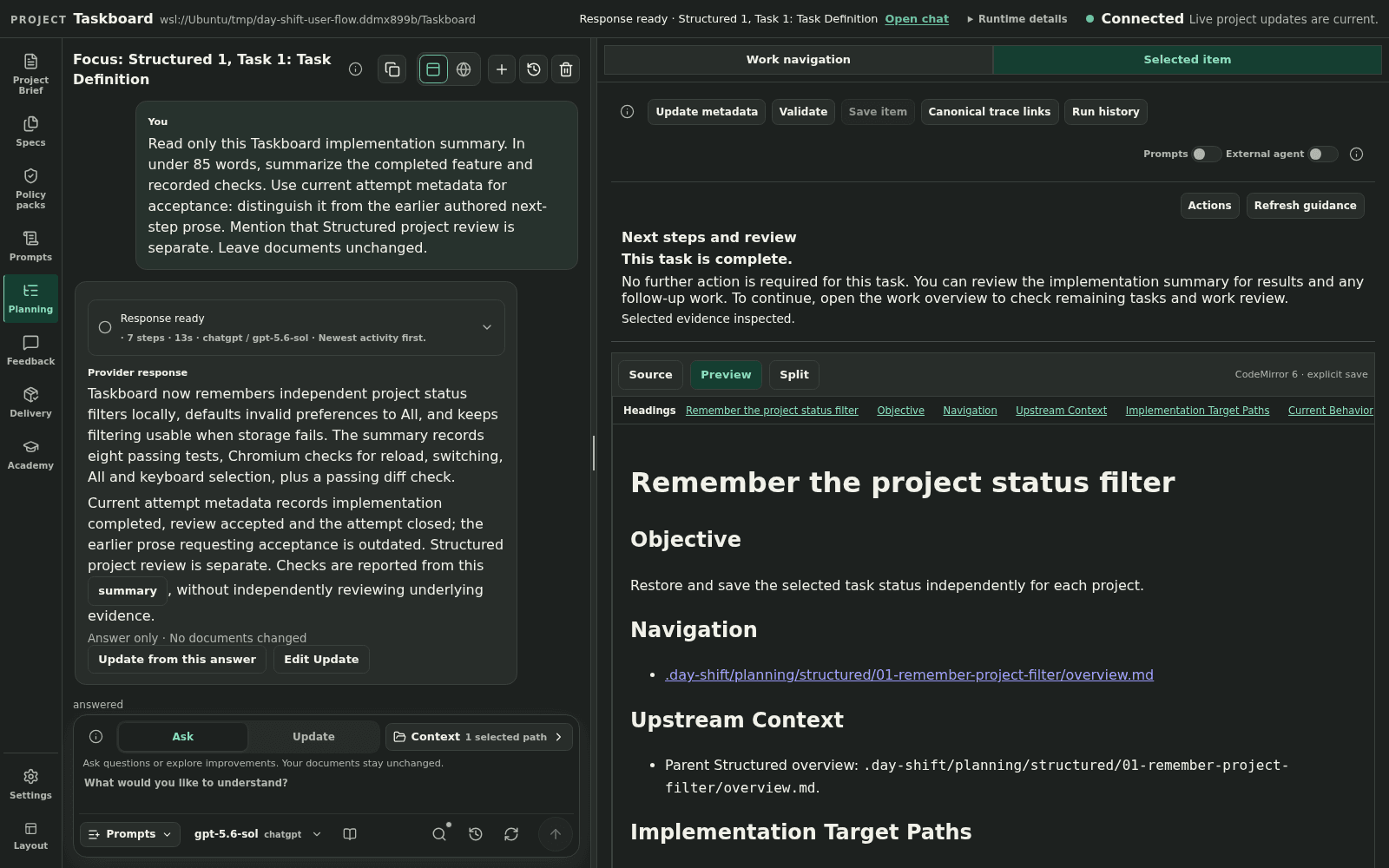
Day Shift demo flow from user goal through planning, implementation evidence, validation, and reconciliation.

Basic

The fastest path for one scoped task. It remains the fastest path for one independent task with resolved scope and is an explicit lower-ceremony choice, not the default planning workflow.

Structured

The normal path for planned feature work. Use the normal planned-feature default when specification-backed work needs one shared overview and no explicit workflow level or parent context overrides it.

Governed

The staged path for formal review and reconciliation. Choose staged planning, formal review, and reconciliation when coordination, risk, or review depth calls for a visible hierarchy.

Artifact hierarchy

The workflow rolls up through visible repository records.

Specs, planning layers, task summaries, validation output, and reconciliation stay connected instead of disappearing into chat history.
Day Shift workflow hierarchy diagram showing planning layers, task evidence, milestone reconciliation, and review routing.

Compatibility evidence

Separate what ran from what was published or structurally checked.

Published archives and validated layouts are not claims of native execution on every listed platform.

Execution tested

Linux x64 with Node 20 and a POSIX shell; runtime requires Node >=20.0.0.

Published release targets

  • macOS x64 and arm64 are listed in the published macOS/Linux system-node archive manifest
  • Linux x64 and arm64 are listed in the published macOS/Linux system-node archive manifest
  • Windows x64 and arm64 are listed in the published Windows system-node archive manifest

Shell and assistant boundary

Bash, Zsh, and Fish completion scripts are exercised by first-party tests. PowerShell is the Windows installer shell.

Day Shift requires no direct coding-assistant integration. Codex is used internally for dogfooding in this repository; that is not independent certification, endorsement, or adoption evidence and is specifically not customer proof. Other assistants are examples of tools users may choose, not tested integrations.

Optional community

Discuss and learn with other Day Shift users.

Day Shift Discord is an optional space for community discussion and peer learning.

Community participation is best effort and does not provide guaranteed response times, private support, entitlement handling, license recovery, security intake, or behavioral enforcement.

Early teams

We are onboarding a small group of design partners.

Day Shift is early, and we are direct about that. Design partners run Day Shift on a real repository, tell us where the workflow helps and where it feels too heavy, and get direct influence on the workflow plus a discount on their first covered release-line license.

Keep the next handoff visible

Put the plan, implementation evidence, and review in the repository.

Start locally, keep using the coding assistant that fits the work, and give every contributor a durable place to continue.